Some buildings survive history. And there is one that history tried to burn down four times: Moscow’s Bolshoi Theatre. Today it is one of the world’s most celebrated opera and ballet houses, its facade graces the 100-ruble banknote, and every evening six underground levels hide stage machinery so deep that even the Moscow Metro passes beneath it. Yet none of this began grand: it started with a license signed by an Empress and a prince who went bankrupt trying to keep it alive.
1776: The Prince, the Empress, and the English Tightrope Walker
The story begins on March 28, 1776, when Empress Catherine II granted Prince Pyotr Urusov the exclusive privilege to “hold theatrical performances of all kinds, concerts, vauxhalls, and masquerades” for ten years. The prince partnered with an eccentric Englishman, Michael Maddox—a tightrope walker by profession, an impresario by calling—and together they built the first theater on Petrovka Street.
Then came the first tragedy: Urusov’s building burned down before it even opened. Maddox was left alone at the helm and, between 1776 and 1780, built the Petrovsky Theatre, which inaugurated on December 30, 1780, with the prologue “The Wanderers” and the ballet “The Magic School.” It cost 130,000 silver rubles—50,000 more than budgeted. Seating held around 1,000 spectators across the stalls, three tiers of boxes, and a gallery. In its first fourteen years, 425 opera and ballet productions premiered there.
By 1794, debts overwhelmed him: Maddox surrendered the theater to the Crown, and the Petrovsky became an imperial theater.
The Four Fires
If the biography of the Bolshoi had to be summed up in a single word, it would be “phoenix.” Fire claimed it four times:
- 1780. The very first stage, still domestic, inside a mansion on Znamenka Street, burned down and ruined Prince Urusov.
- 1805. Maddox’s Petrovsky Theatre, after 25 years of life, was reduced to ashes. The troupe wandered among the private theaters of the Moscow aristocracy.
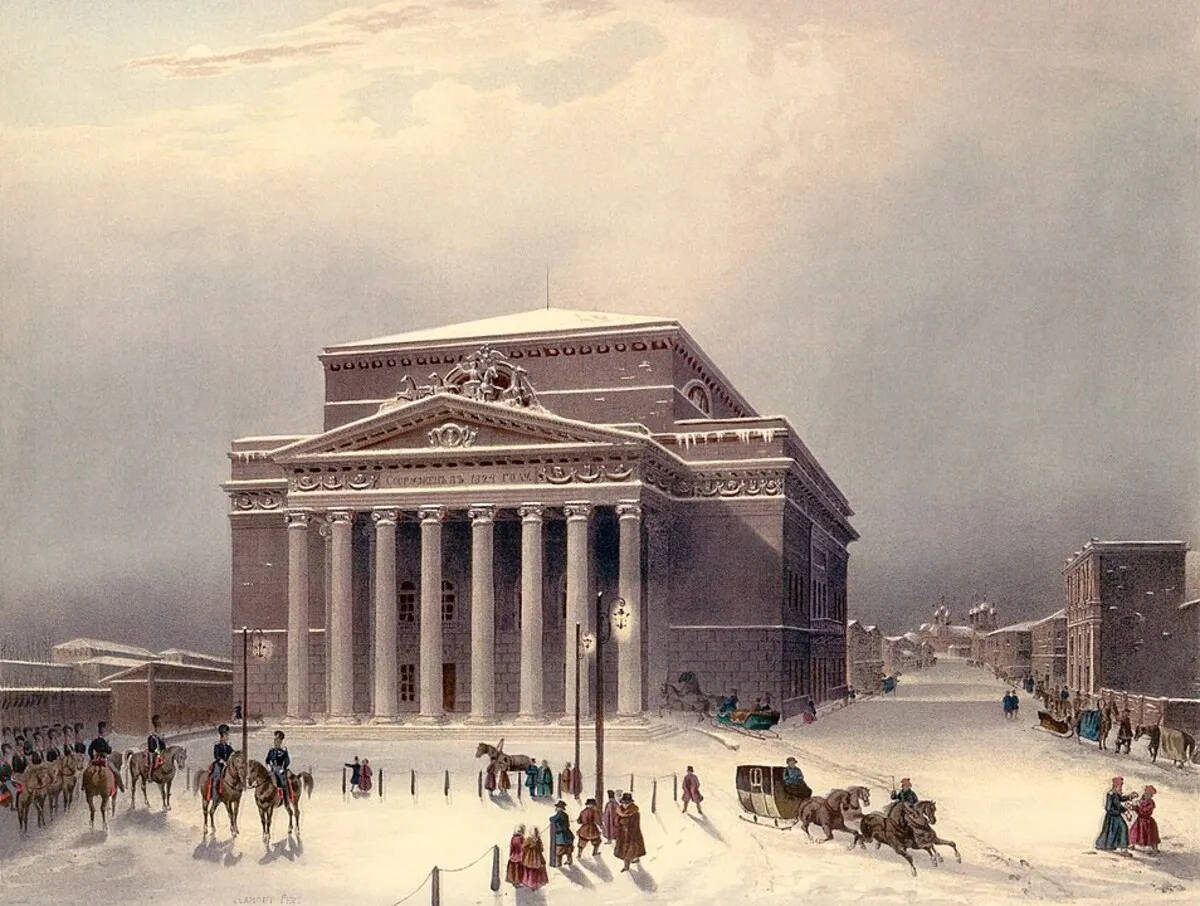
- 1812. Carlo Rossi erected a wooden theater on Arbatskaya Square (1808)—and Napoleon entered Moscow. The Great Fire of Moscow devoured it among the very first buildings to burn.
- 1853. The most dramatic blaze. On March 11 (23), for three days, flames consumed sets, costumes, instruments, and the entire music library. Only stone walls and the portico columns remained standing. The cause: a stagehand smoking where he shouldn’t have. An iron fire curtain existed to separate stage from auditorium, yet that night no one lowered it.
1825 and 1856: Two Rebirths That Shaped Its Face
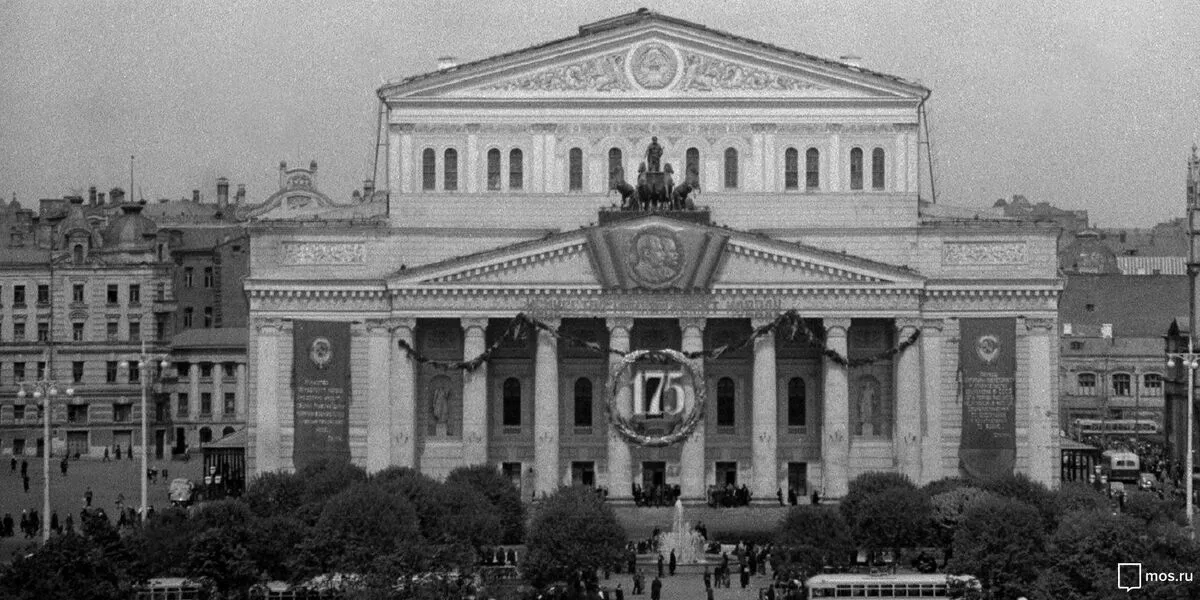
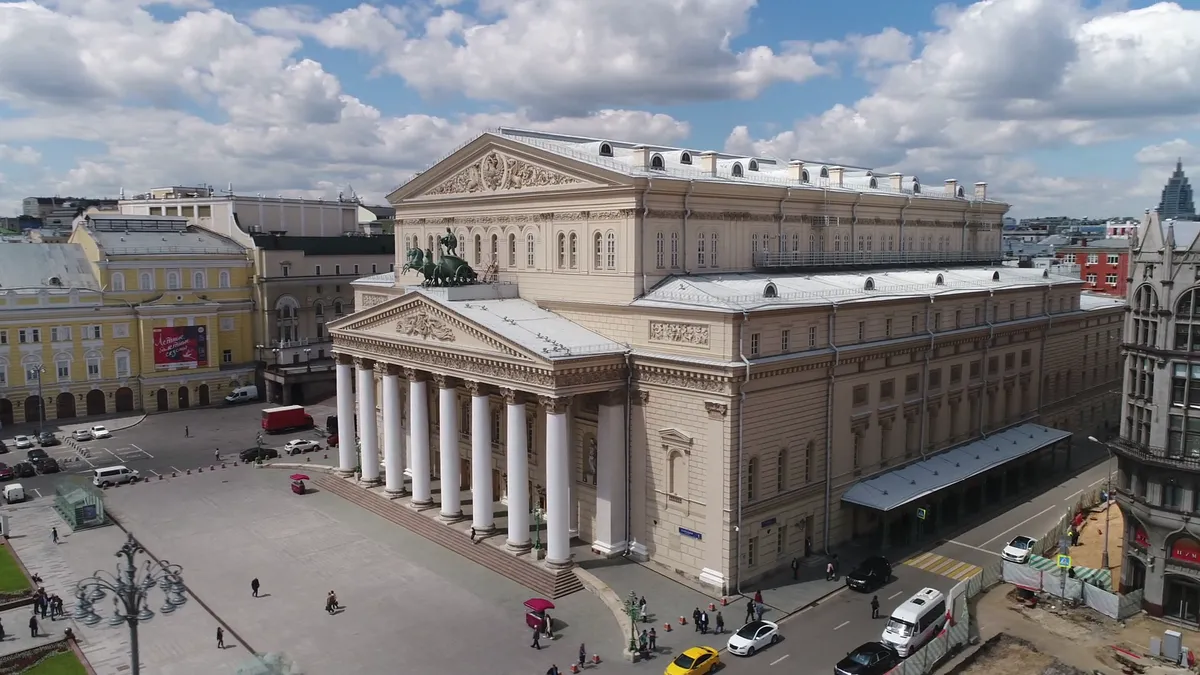
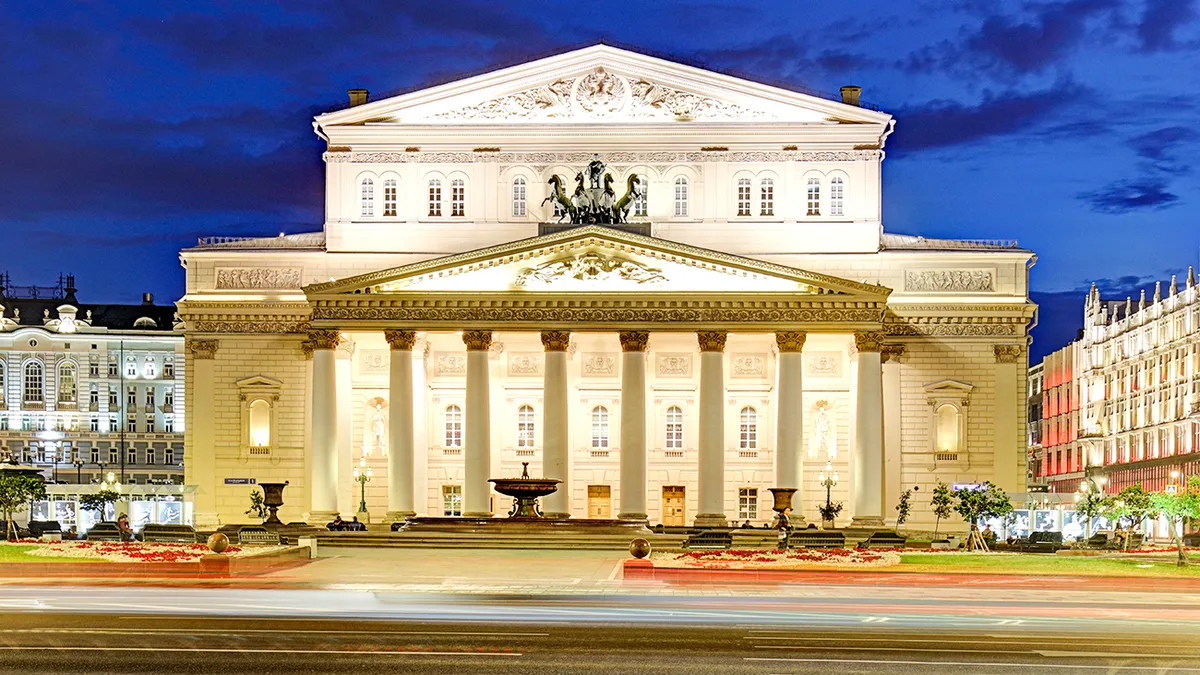
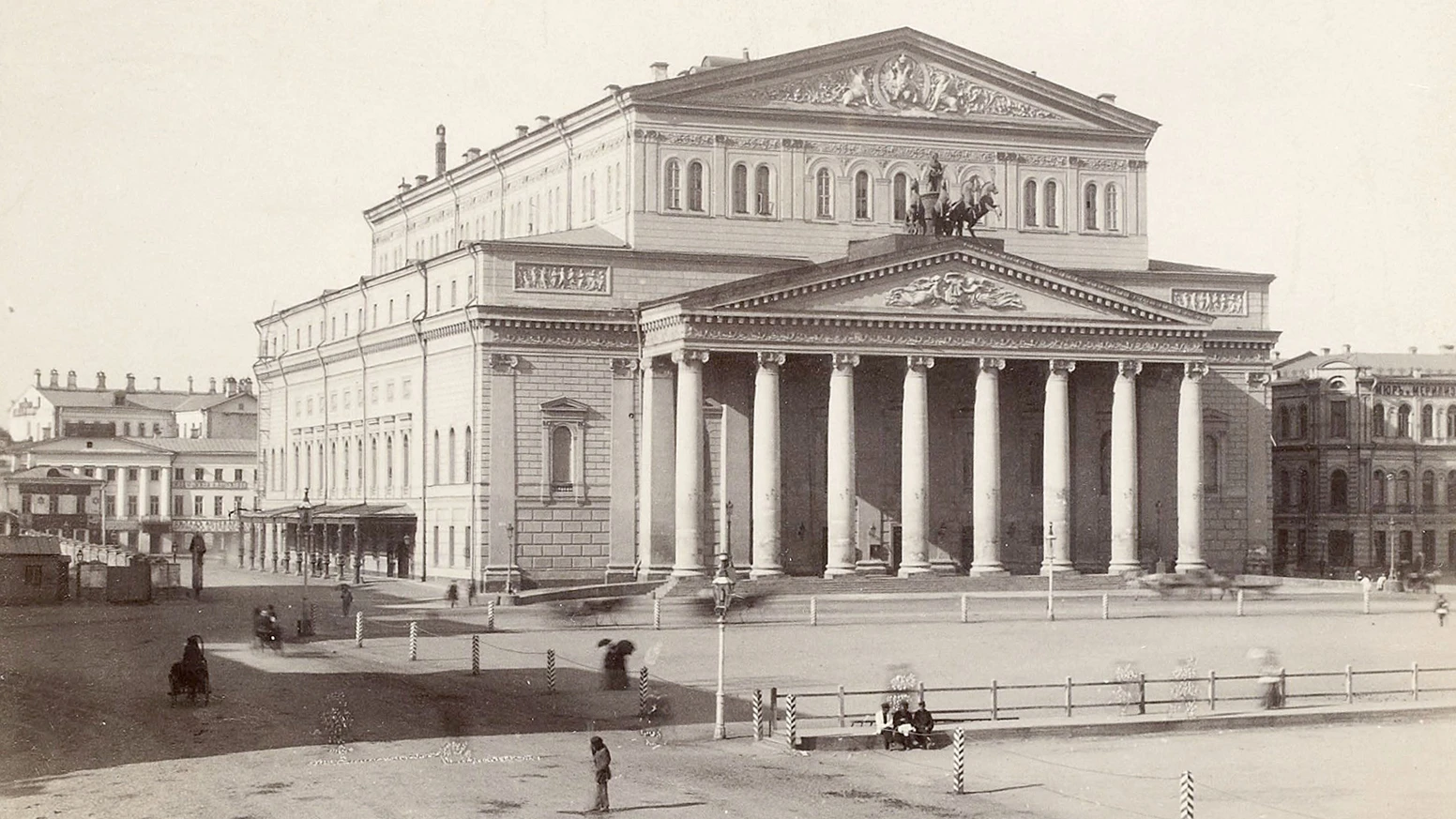
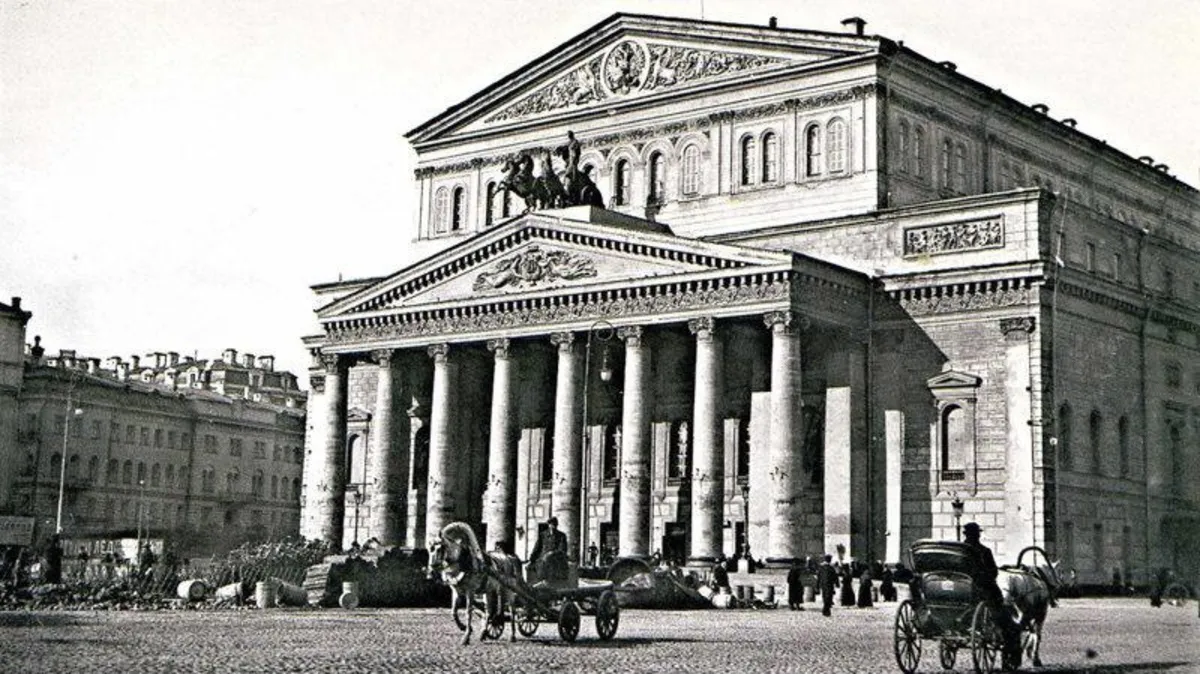
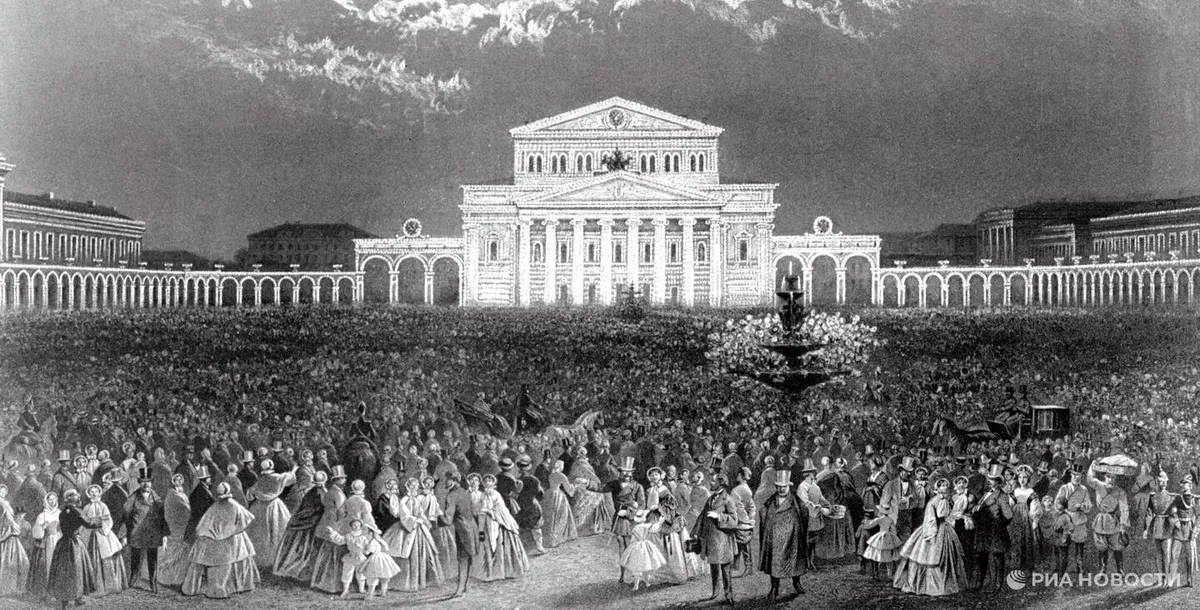
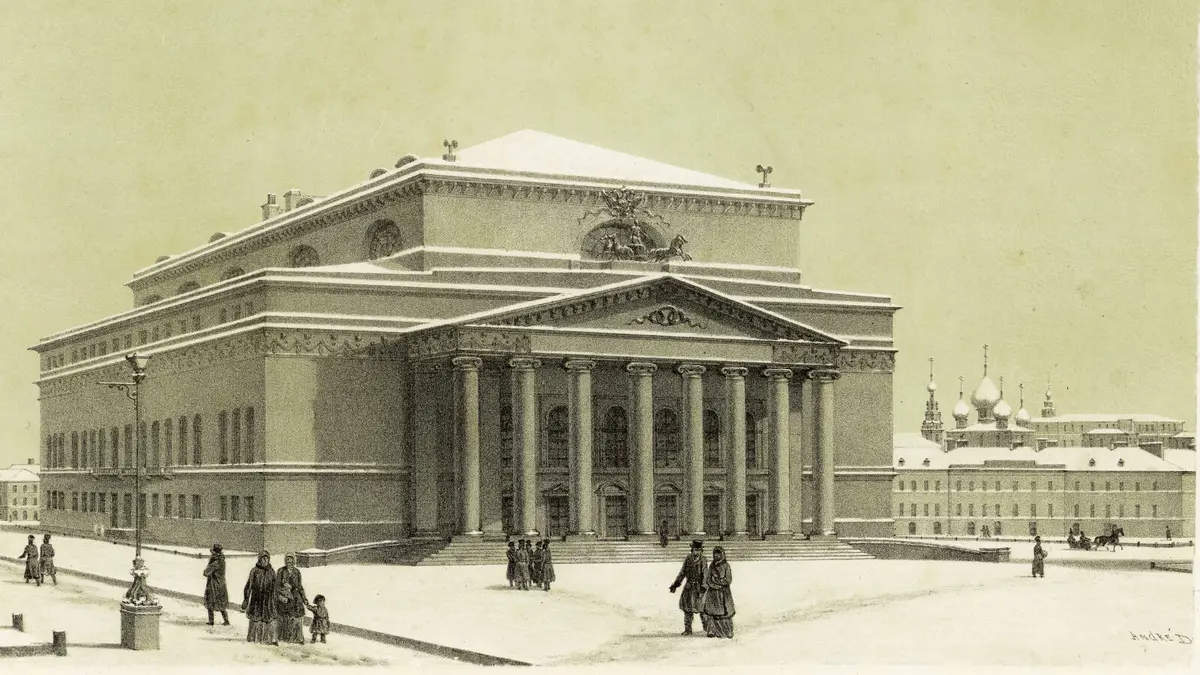
Following Napoleon’s defeat, Moscow wanted to rise again on a grand scale. In 1825, the Great Petrovsky Theatre opened, built by Osip Bove after a design by Andrei Mikhailov: eight columns, a classical portico, and a winged Apollo driving three horses (the fourth was still missing). It was larger than the theater in the imperial capital itself, St. Petersburg—hence the name that stuck forever: “Bolshoi” (“the Great”).
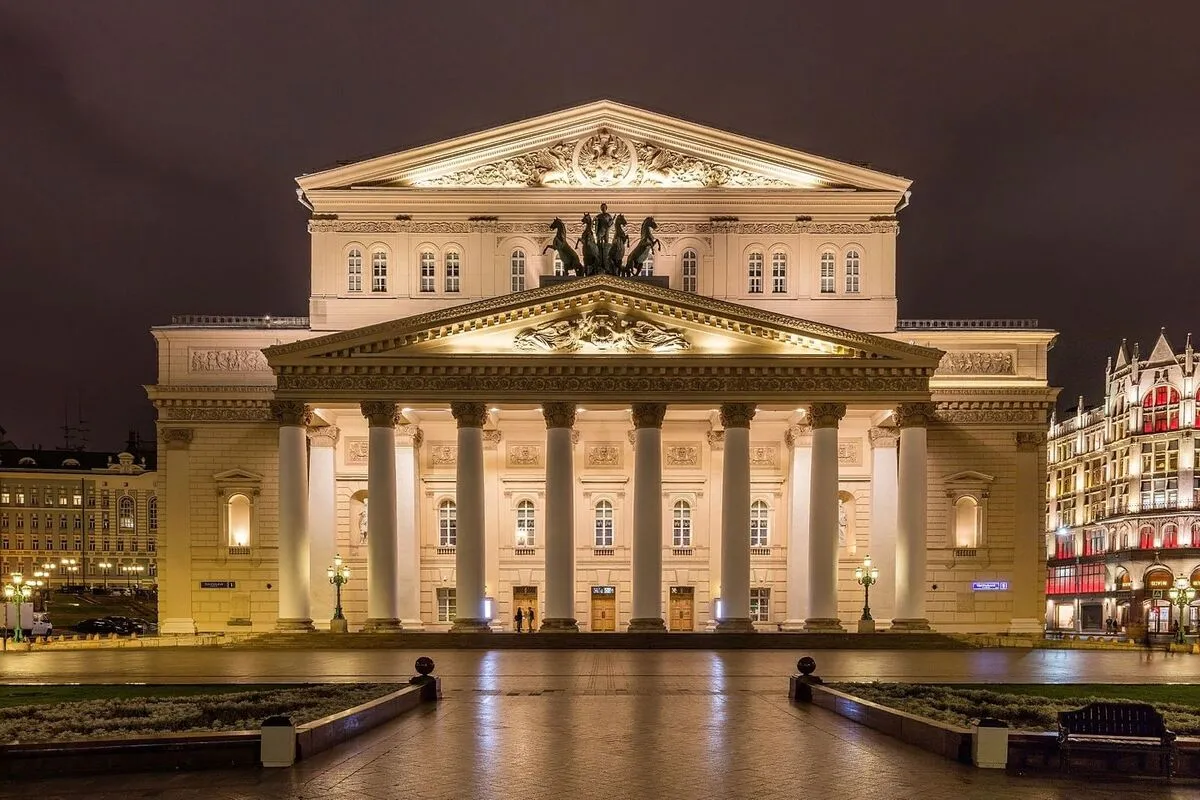
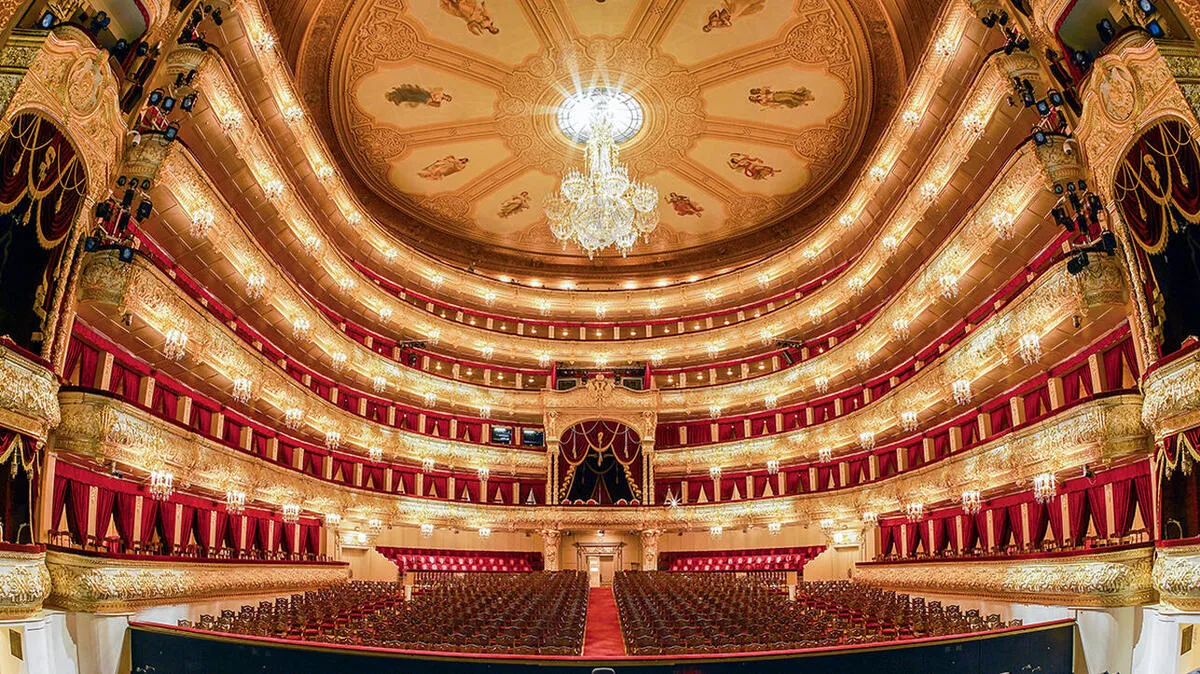
After the 1853 fire, architect Alberto Cavos—son of an opera composer—rebuilt the house in record time because History was in a hurry: the theater had to be ready for the coronation of Alexander II. It reopened on August 20, 1856, with Bellini’s “I Puritani.” Cavos perfected the acoustics down to the finest detail (even the seat upholstery aided resonance), placed Pyotr Klodt’s famous bronze quadriga of Apollo atop the pediment, and shaped the auditorium we know today.
Balconies, Boxes, and Vertical Hierarchy
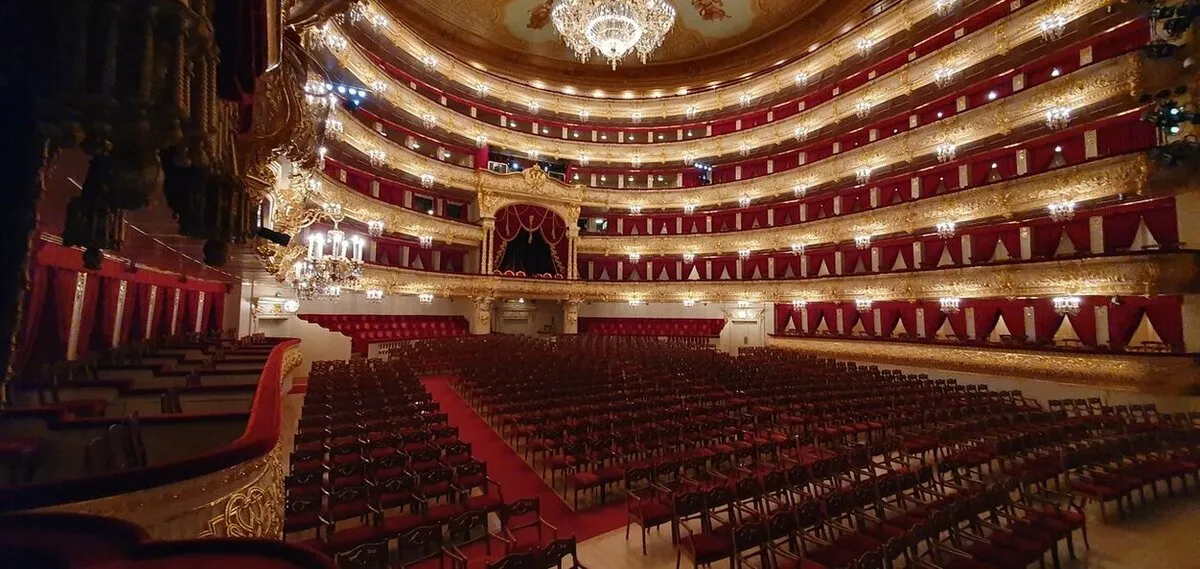
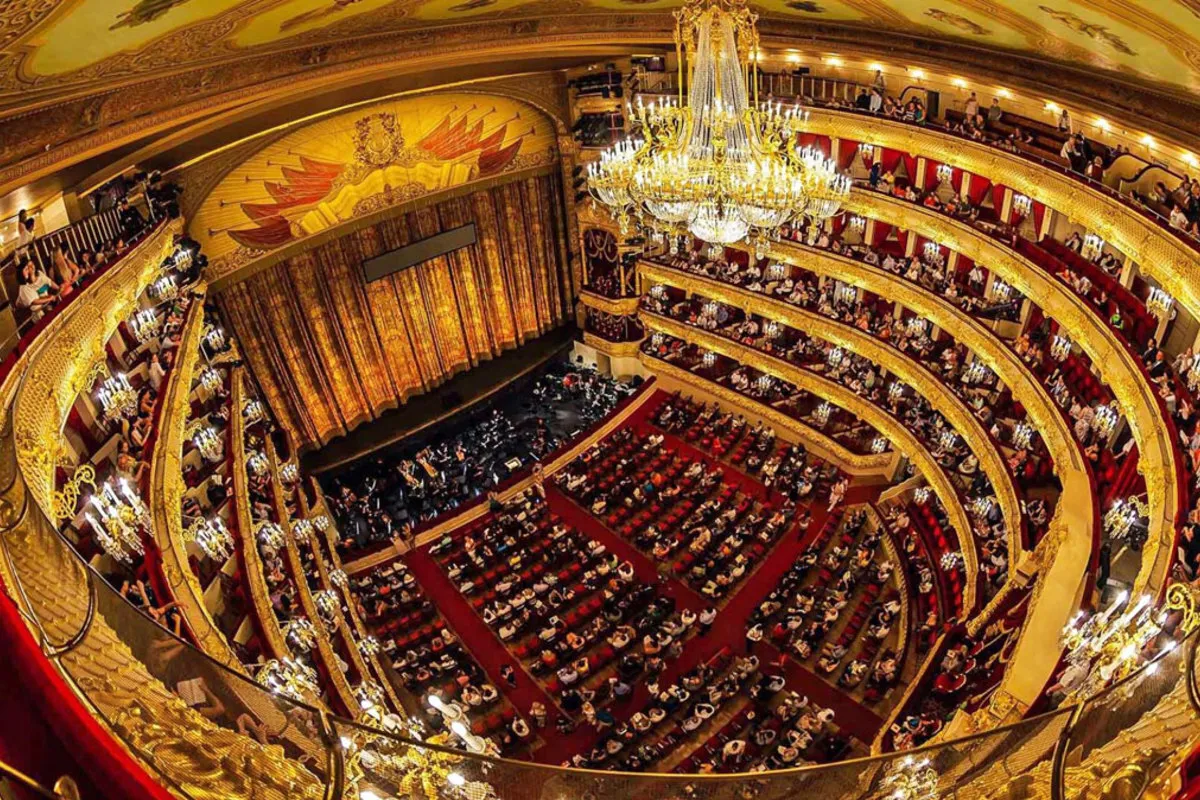
The Bolshoi auditorium is simultaneously a masterclass in engineering and social order. Five tiers of boxes wrap around the fan-shaped stalls: Cavos’s acoustics carry an unamplified voice clearly to the very last seat. During the 19th century, the boxes formed a social map of their own: those closest to the stage were leased by noble families, while the Imperial Box beneath the quadriga marked the center of power. Following the 2005–2011 restoration, seating capacity was reduced from 2,155 to 1,740 seats—fewer chairs, greater comfort, and superior sound.
Censorship: From the Tsar to the Politburo
The history of the Bolshoi is also the history of what could and could not be spoken on stage. Even under the Empire, texts were scrutinized, yet it was during the Soviet era that censorship became master of ceremonies:
- After the 1917 Revolution, the theater was nationalized, and attempts were made to shut it down completely; on December 12, 1919, a failed decree came close to liquidating it.
- When it reopened in 1943 during wartime, Glinka’s “A Life for the Tsar” had to be renamed and “purged”—its “monarchist stain” scrubbed from the libretto to make it politically acceptable.
- Prokofiev endured the regime’s shifting tides: the apotheosis of his opera “War and Peace” was rewritten, and a triumphal march was composed to order for the 1945 Victory Parade.
- During the Stalinist years, the Bolshoi served as an obligatory showcase: party congresses and state ceremonies took place there, and artists danced under the gaze of Soviet leaders. A single performance could launch a career—or seal a fate.
- Even the curtain spoke politics: in 1955, a tapestry weighing over a ton of gold thread and silk was hung bearing the inscription “USSR” repeated 26 times. It was replaced in the 1990s, and after the 2011 restoration a new fireproof curtain imitating natural silk with metallic gold thread was installed.
Censorship even reached the roof: during World War II, a bomb damaged part of the building and the blast wave “undressed” Apollo on the quadriga, tearing off his laurel wreath and fig leaf. For decades, officials debated whether the god should remain clothed or bare. During the 2011 restoration, both the wreath and the leaf were returned—designed to be detachable, just in case politics ever changes its mind.
2005–2011: The Billion-Dollar Resurrection
In 2005, the Bolshoi closed for what was expected to be a three-year renovation. It ended up taking six, at an official cost of 21 billion rubles—around $688 million—though some estimates place the total closer to $1.1 billion. What was accomplished:
- Over 75% of the structure was found to be unstable. The building was jacked up onto temporary pillars while a 20-meter-deep basement was excavated: six underground levels housing dressing rooms, storage vaults, and rehearsal halls.
- 2,300 rotting wooden piles were replaced with reinforced concrete.
- The original imperial decor was recovered, Soviet emblems were removed (the state crest on the pediment was replaced by the double-headed eagle), and the historic beige-and-olive palette was restored. Roughly 4.5 kg of gold leaf was used to gild 890 m² of stucco.
- Most importantly, Cavos’s original acoustics, lost during Soviet alterations, were fully restored.
On October 28, 2011, the Bolshoi reopened with a gala concert. More than 3,500 workers—including nearly a thousand specialist restorers—labored on site every single day.
The Bolshoi Today
In 2026, the theater celebrated its 250th anniversary. It operates three stages: the Historic Stage (the 1856 jewel), the New Stage (opened in 2002 for experimental and chamber productions), and the Beethoven Hall, a transformable space where the floor rises and literally “swallows” the seats. An evening at the Bolshoi today is, at last, what it was meant to be from the start: the finest voices, the finest dance, and a building with nothing left to prove—though Apollo, just to be safe, keeps his detachable leaf.
Cultural & Performing Arts Connection
If you are fascinated by classical dance and want to discover how the dancers who grace this legendary stage train and prepare, we invite you to read Behind the Scenes of Russian Ballet: Movements, Pain, and Hidden Secrets.
Would you like to attend an opera or ballet gala at the Bolshoi Theatre during your stay in Moscow without worrying about ticket scalpers or language barriers? We arrange official tickets with full guarantee. Request your Russia show tickets here or explore our Moscow private tours.